
The formation of the Moon remains one of the most dramatic and least understood episodes in planetary history. According to the Giant Impact hypothesis, a Mars-sized impactor collided with the proto-Earth, producing enough energy to melt and partially vaporize both bodies and forming a hot, massive disk of silicate material—the protolunar disk. This event set the stage for the formation of the Earth-Moon system as we know it. Yet, despite decades of work, the physical and chemical conditions in the disk remain poorly constrained. Models of this event depend critically on thermodynamic properties of silicates and rocks at extreme temperatures and pressures—properties that are still largely inaccessible to experiments and often poorly described in theoretical models.
The ERC-funded IMPACT project tackled this challenge head-on. We combined advanced ab initio molecular dynamics with state-of-the-art electronic structure methods to derive equations of state and phase boundaries for major rock-forming minerals and silicate melts under Giant Impact conditions. This work allowed us to locate supercritical points, track vaporization curves, and simulate fluid behavior within the disk. By bridging the atomic, mesoscale, and planetary regimes, we tried to model the thermodynamics of the protolunar disk, the balance between liquid and vapor phases, and the chemical speciation of volatile and refractory components. These simulations helped constrain the evolution of the protolunar disk, ultimately contributing to a more coherent picture of how the Moon formed and how its composition reflects the aftermath of a planet-shaping collision.
Here is a selection of some of the most remarkable results:
No magma ocean surface after giant impacts between rocky planets
* Giant impacts release enough energy to bring portions of the bodies to supercritical states.
* Cooling and condensation of some of the post-impact system takes place at supercritical conditions.
* There is no magma ocean – atmosphere interface after most giant impacts between rocky planets.
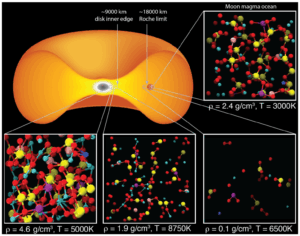
No magma ocean surface after giant impacts between rocky planets
Razvan Caracas, Sarah T. Stewart
Earth and Planetary Science Letters, 608, 118014 (2023)